Confused About How Blockchain Actually Works?
Many people hear the word blockchain from Bitcoin, crypto, NFT, or Web3.
But when trying to understand it, reactions often appear like:
“Blockchain is complicated”

DRX Admin
Many people hear the word blockchain from Bitcoin, crypto, NFT, or Web3.
But when trying to understand it, reactions often appear like:
“Blockchain is complicated”
“Do I need to understand coding first?”
“This is only for crypto, right?”
In fact, the basic concept of blockchain can actually be understood very simply.
You do not need to be a programmer or a big investor to understand blockchain.
Just imagine blockchain as a super secure digital ledger that can be viewed by many people, is difficult to manipulate, and is not controlled by just one party.
This article will help you understand how blockchain works in a simple way from scratch, without confusing technical terms.
Blockchain is a digital recording system that stores data in connected blocks that are secure, transparent, and difficult to change.
The Easy Version:
Blockchain = Online ledger + many copies + locked together
Means:
To understand blockchain, let’s start with a simple analogy.
Traditional Ledger:
For example, you own a small shop.
Every transaction is recorded in a book:
The problem:
If the book is lost, damaged, or altered, the data can be wrong or even problematic.
Blockchain:
Now imagine that ledger:
The result?
More secure, transparent, and trustworthy.
Let’s simplify the process.
Example:
Andi sends 1 token to Budi.
This request enters the blockchain network.
Computers in the network (known as nodes/validators) check:
If valid, the transaction continues.
Several transactions are combined into one package called a block.
Like one new page in a ledger.
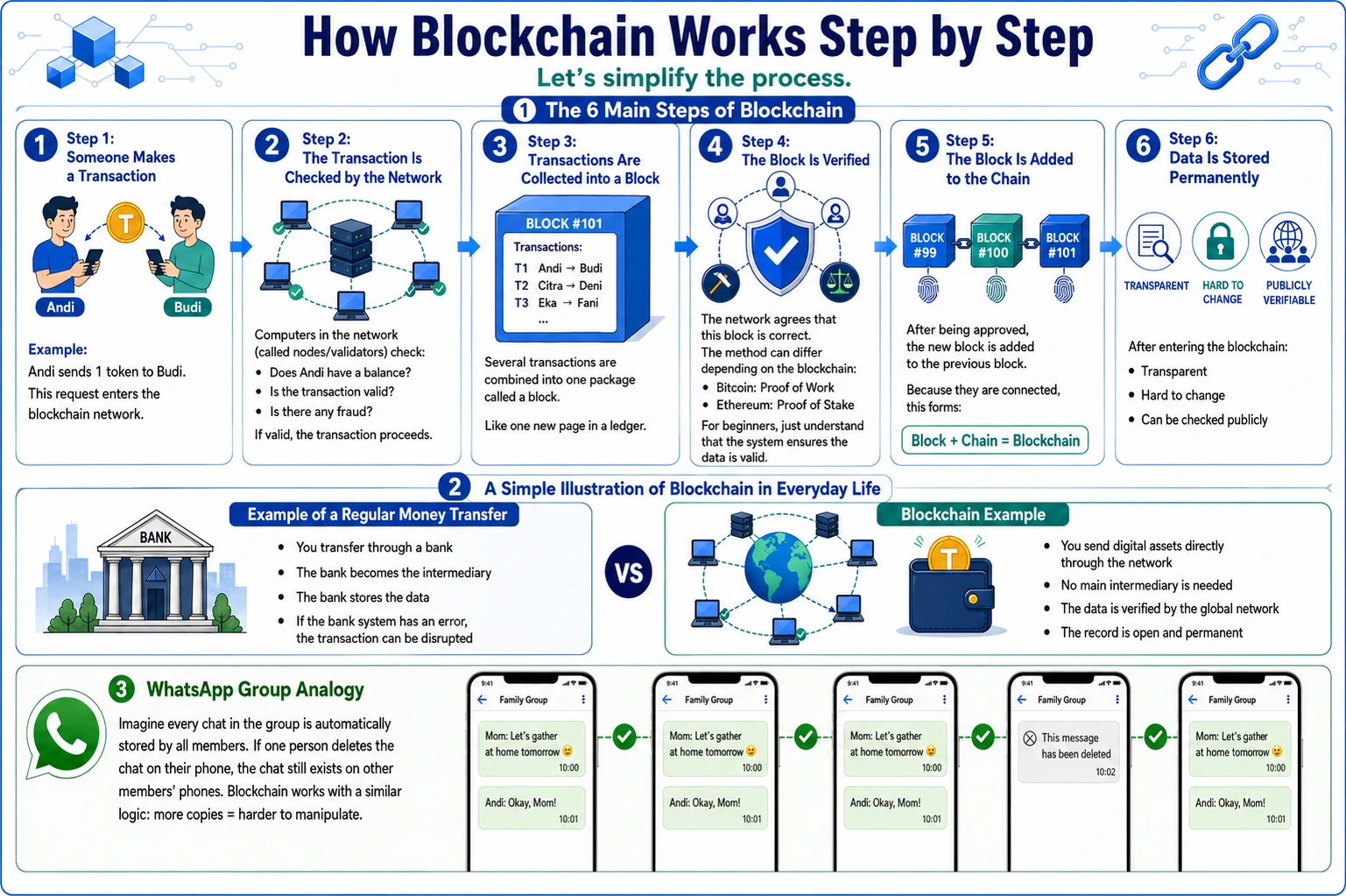
The network approves that the block is correct.
The method can differ depending on the blockchain:
For beginners, just understand that the system ensures the data is valid.
After approval, the new block is added to the previous blocks.
Because they are connected, it forms:
Block + Chain = Blockchain
Once entered into the blockchain, the data becomes:
Simple Blockchain Illustration in Everyday Life
Example of Regular Money Transfer:
You transfer money through a bank, The bank becomes the intermediary, The bank stores the data, If the bank system has an error, the transaction can be disrupted.
Example of Blockchain:
You send digital assets directly through the network, No main intermediary is needed, Data is verified by the global network, Records are open and permanent.
WhatsApp Group Analogy:
Imagine every chat in a group is automatically stored by all members. If one person deletes the chat on their phone, the chat still exists on other members’ devices. Blockchain works with a similar logic: many copies = harder to manipulate.
Each block is connected to the previous block. If one piece of data changes, the entire chain changes and the network immediately notices.
There is not just one server. Data is distributed across many computers.
Many blockchains can be checked publicly. You can see transactions without knowing the personal identity of the users.
Because it requires network approval, not just one party.
No system is perfect.
What is usually problematic is often not the blockchain itself, but
So blockchain technology is strong, but users still need to be smart.
Blockchain is not just about crypto.
1. Cryptocurrency
Bitcoin, Ethereum, stablecoin
2. Smart Contracts
Automatic agreements without intermediaries.
Example: automatic payment when conditions are fulfilled.
3. NFT
Proof of digital ownership
4. Supply Chain
Tracking products from factories to consumers
5. Ticketing & Membership
Anti-counterfeit event tickets
6. Sport Web3
Ecosystems like DRX Token can utilize blockchain for:
1. Blockchain = Bitcoin
Wrong.
Bitcoin is just one use of blockchain.
2. Blockchain Is Only for Trading
No.
Blockchain is also used for data, tickets, contracts, and digital identity.
3. Blockchain Is Always Anonymous
Not completely.
Many transactions are transparent, only the identities are not always directly visible.
4. All Blockchain Are the Same
Different blockchains have different functions.
Example:
As your understanding grows, you will also encounter terms such as:
Automatic programs on the blockchain, or you can read more in What is a Smart Contract.
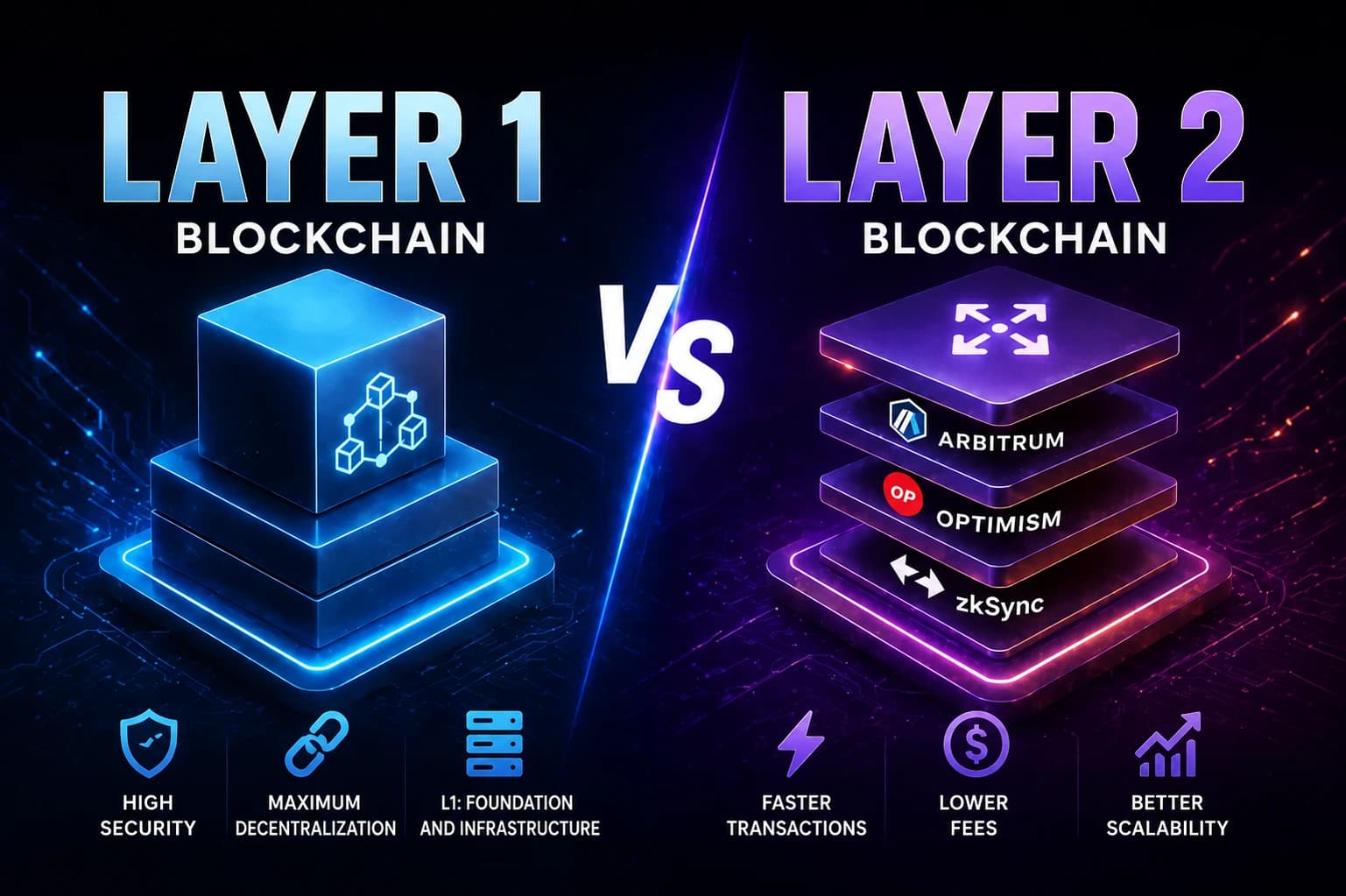
Main blockchains such as Ethereum or Solana. For more details check What Is Layer 1 Blockchain?
If you want to know more about its functions and uses, you can read the article Examples of Blockchain Usage.
For complete blockchain basics read about What Is Blockchain.
Blockchain is beginning to move toward real utility.
The focus is not only on token prices, but also:
In sport Web3, this technology can become the foundation for stronger relationships between brands, athletes, communities, and fans.
Blockchain is actually not as complicated as it seems.
The point is:
Blockchain is a digital recording system that is:
Simply put:
Someone makes a transaction → The network verifies it → Added into a block → Added to the chain → Stored permanently
By understanding these basics, you are already one step ahead of many people who only follow hype without understanding the technology.
No. Blockchain is also used for smart contracts, NFTs, supply chains, digital tickets, and much more.
Technologically, it is very secure, but users still need to be careful of scams.
Because it enables digital systems that are transparent, efficient, and minimally manipulated.
No. Basic understanding can be learned by anyone.
Blockchain is the main foundation of Web3.
Understanding how blockchain works simply helps you realize that this technology is much bigger than just crypto or trading.
Blockchain is the foundation for future ecosystems, including web3, fan engagement, and real utility such as DRX Token which connects technology with the needs of the modern sports industry.

Share


Published Date:07 Mei 2026• Read Time:7min
Published Date:05 Mei 2026• Read Time:7min

Published Date:04 Mei 2026• Read Time:7 menit
Published Date:30 Apr 2026• Read Time:7min

Published Date:29 Apr 2026• Read Time:5min