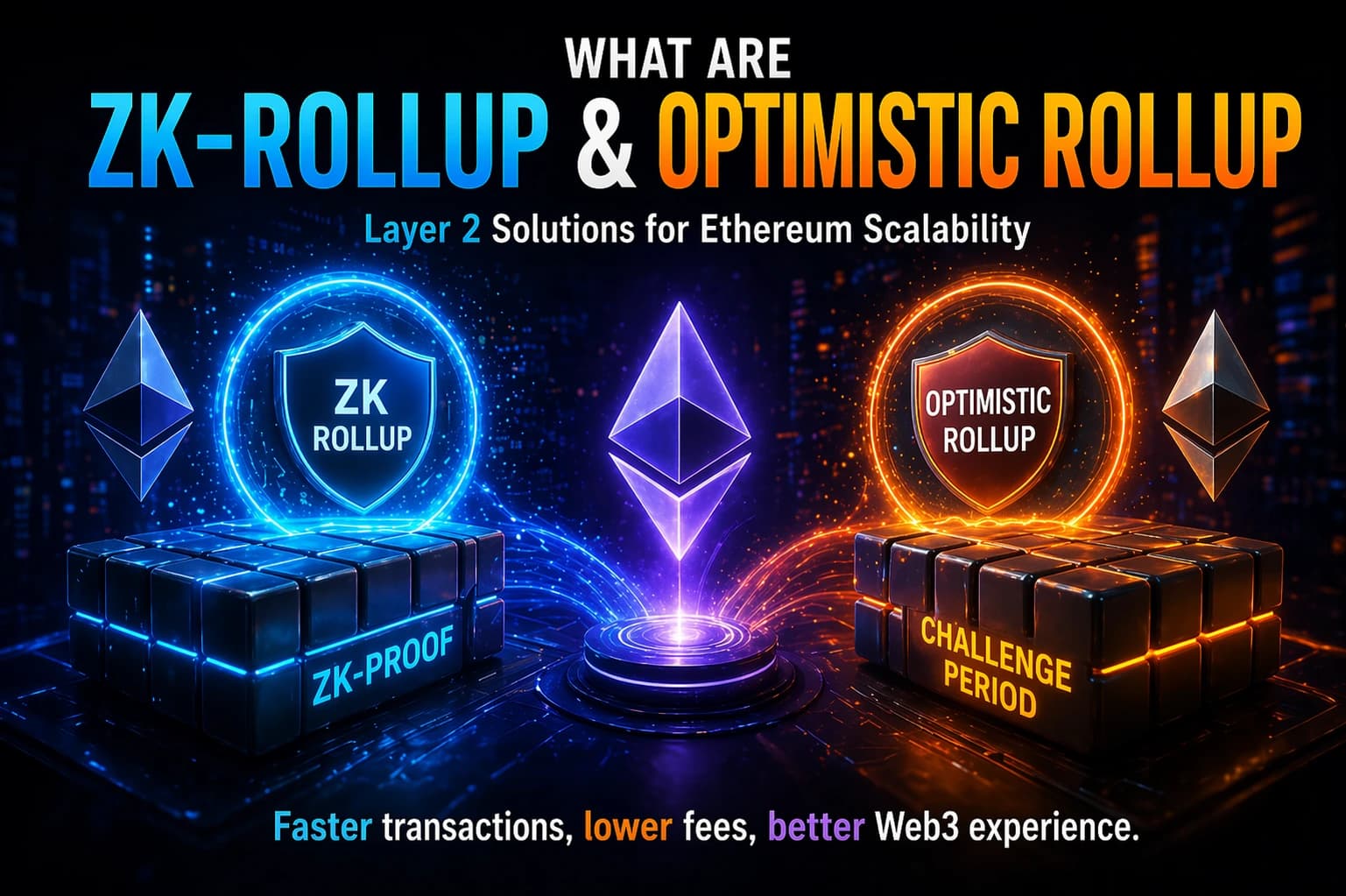
Rollup = Rolling (batching) many transactions into one large package, then sending it to the main blockchain (Layer 1).
Why is this important?
- Reduce the load on the main network
- Save costs
- Increases throughput
Imagine like:
Instead of sending 100 packages one by one, you send them all in one container.
Types of Rollup: zk vs Optimistic
1. zk-Rollup (Zero-Knowledge Rollup)
Main concept: Instant validation with mathematical proof
Simple workflow:
- Transactions are collected on Layer 2
- The system generates a zero-knowledge proof
- This proof is sent to Layer 1
- Layer 1 verifies instantly without checking all data
Advantages:
- Fast finality (instantly valid)
- High security based on cryptography
- More efficient in the long term
Disadvantages:
- Complex technology
- Expensive to development
2. Optimistic Rollup
Main concept: Assuming transactions are valid (optimistic)
Simple workflow:
- Transactions are collected and sent to Layer 1
- Assumed valid without direct verification
- There is a “challenge period” (usually several days)
- If there is fraud, transactions can be canceled
Advantages:
- Technically simpler
- Easier to implement
Disadvantages:
- Slower finality
- Risk of delay if disputes occurs
Step-by-Step How It Works (Technical Flow)
A. zk-Rollup Flow
- User makes a transaction
- Transactions are collected (batching)
- The system creates a zero-knowledge proof
- Proof is sent to Layer 1
- Layer 1 verifies the proof
- Transactions are considered final
B. Optimistic Rollup Flow
- User makes a transaction
- Transactions are collected
- Data is sent to Layer 1
- Assumed valid
- Challenge window is opened
- If there is no challenge → final
Case Study: Real Implementation in Blockchain
zk-Rollup Projects
- zkSync
- StarkNet
Used for:
- DeFi (fast & cheap trading)
- NFT marketplace
- Payment system
Optimistic Rollup Projects
- Optimism
- Arbitrum
Used for:
- DeFi Application
- Complex smart contracts
- dApps ecosystem
Comparison Between zk-Rollup vs Optimistic Rollup
| Aspect | zk-Rollup | Optimistic Rollup |
| Validation | Cryptographic proof | Assumed valid |
| Final speed | Fast | Slower |
| Security | Very high | High (with challenge) |
| Complexity | High | Simpler |
| Long-term cost | More efficient | More efficient |
Future Trends of Rollup
In the coming years, rollups are predicted to become the main standard for blockchain scaling.
Emerging trends
- zk-rollup becoming more dominant
- Integration with AI & data layer
- Layer 2 becoming the default user experience
Even the Ethereum roadmap itself is moving toward:
“Rollup-centric future”
It means:
The future of blockchain will heavily rely on rollups.
Connection to Web3 & DRX Ecosystem
This technology is not just theory—it has a direct impact on real applications.
In Web3 ecosystems such as What is DRX Token.
Rollups allows:
- Fast transactions for fan engagement
- Reward systems without high fees
- Community activities without friction
Example:
- Sports community voting
- Token reward distribution
- Digital asset marketplace
Without Layer 2, all of this would be expensive and slow.
Conclusion
zk-rollup & optimistic rollup are the main solutions to blockchain scalability issues.
The key differences:
- zk-rollup → fast & proof based
- optimistic rollup → flexible & assumption based
Both play an important role in:
- The future of Web3
- Digital economy
- Decentralized systems
If blockchain is the foundation, then rollups are the accelerator.
FAQ
What is the main difference between zk-rollup and optimistic rollup?
zk-rollup uses cryptographic proofs, while optimistic rollup assumes transactions are valid and opens a challenge window.
Which is faster?
zk-rollupis faster due to instant finality.
Are rollups secure?
Yes, both are secure because they still rely on the security of Layer 1 such as Ethereum.
Why are rollups important in the future?
Because they increase scalability without sacrificing security.
Will all blockchains use rollups?
The trend is moving in that direction, especially for large ecosystems like Ethereum.
Ready to Enter the Future of Web3?
Technologies like zk-rollup & optimistic rollup open great opportunities for the digital ecosystem.
With faster and cheaper infrastructure, now is the best time to:
- Understand Web3
- Join blockchain-based ecosystems
- Take advantage of new digital opportunities
Start your journey with DRX and become part of the Web3 revolution today.