- How it is used
- The purpose of the transaction
- The risks taken
For a basic understanding of crypto, also read What Is Cryptocurrency.
The Scholars’ Opinion Towards Crypto
It should be understood that there is no single unified opinion in Islam regarding crypto. Because the Scholars have different perspectives.
1. The Perspective That Tends to Prohibit Crypto
Some scholars and institutions argue that crypto does not meet the requirements as a legitimate currency or asset.
Example:
- The Indonesian Ulema Council states that crypto as a currency is considered haram because it contains gharar and does not have a clear underlying.
Main reasons:
- High volatility
- No official authority
- Potential excessive speculation
2. The Perspective That Permits (With Conditions)
Other scholars see crypto as a legitimate digital asset, as long as it meets sharia principles.
This approach views crypto as:
- A commodities (like digital gold)
- Not a primary currency
Conditions usually proposed:
- Not used for extreme speculation
- Does not involve fraud
- Utilized transparently
Reasons That Consider Crypto Halal
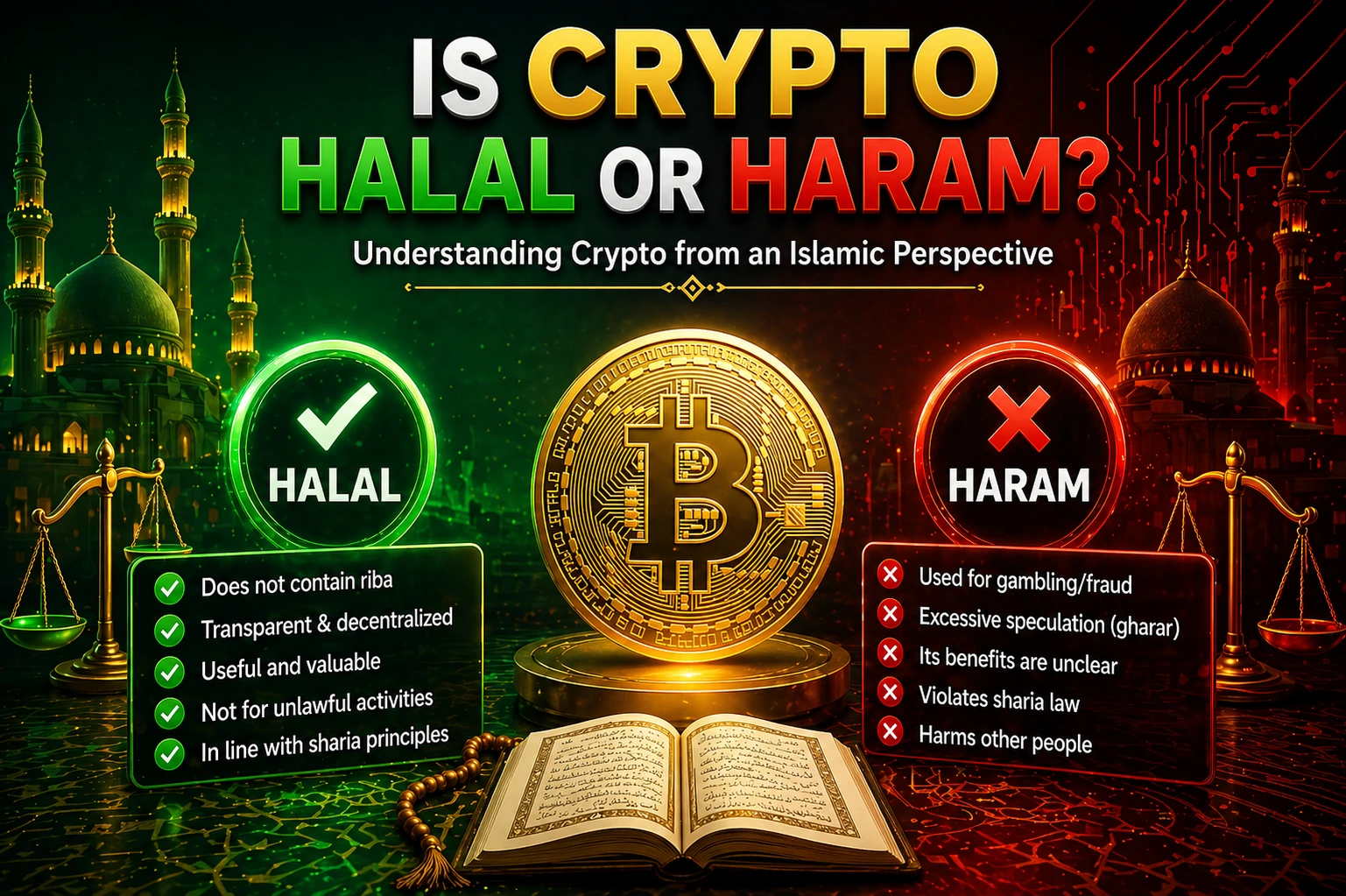
Here are some arguments that utilized by those who permit it:
1. Considered as a Digital Asset
Crypto can be positioned like:
- Gold
- Property
- Stocks
As long as there is value and demand, it can be considered as “mal” (wealth).
2. Blockchain Transparency
Blockchain technology is:
- Open
- Cannot be manipulated
- Verifiable
This is even considered more transparent compared to traditional financial systems.
3. Does Not Directly Involve Riba
Crypto transaction generally:
- Do not involve interest
- Do not depend on debt systems
Therefore, some scholars consider it free from riba.
4. Used for Real Utility
Some crypto assets have clear functions:
- Smart contracts
- Payment systems
- Digital ecosystems
This strengthens the argument that crypto is not merely speculation.
Reasons That Considered Crypto Haram
On the other hand, there are also strong arguments that consider crypto haram:
1. Gharar (High Uncertainty)
Crypto prices are highly volatile.
Example:
- Value can rise and fall drastically in a short time
- Difficult to predict
This is considered close to the prohibited element of uncertainty.
2. Speculation (Maisir)
Many people buy crypto with the aim of:
- Short term trading
- Instant profit
If the intention is purely speculative, then it can fall into the category of maisir (gambling).
3. No Clear Underlying Asset
Some scholars questions:
- What is the fundamental value of crypto?
- Is there a real asset behind it?
If unclear, it is considered not meeting the requirements as a legitimate asset.
4. Potential Fraud & Scam
The crypto world is also known for:
- Rug pull
- Ponzi schemes
- Unclear tokens
This becomes a concern from a sharia perspective.
Factors That Determine the Rules of Crypto
Rather than just asking “halal or haram”, it is more important to understand the determining factors:
1. Intention & Purpose
- Long-term investment → safer
- Short-term speculation → more risky from a sharia perspective
2. Method of Use
- Used as a payment tool → different rules
- Used as an asset → may have different rules
3. Type of Crypto
Not all crypto are the same:
- Some have clear utility
- Some are just hype
4. Level of Risk
The higher the risk without a clear basis → the closer it is to gharar.
5. User Knowledge
Lack of education can cause someone to:
- Fall into scams
- Make wrong decisions
Also learn about Safe Ways to Invest in Crypto.
A Wise Approach for Muslims
In situations of ikhtilaf like this, the best approach is:
- Avoid doubtful matters (syubhat)
- Focus on uses that have clear benefits
- Do not be impulsive in taking risks
Islamic Principle:
“Leave what is doubtful for what is not doubtful.”
Conclusion: Halal or Haram?
Crypto cannot be generalized as entirely halal or haram.
Neutral conclusion:
- There are scholars who prohibit it
- There are those who permit it with conditions
- The rules depends on the context of its use
As a Moesleam, the best steps are:
- Understand the risks
- Follow the opinion of trusted scholars
- Prioritize caution
FAQ
Is crypto halal according to the Islam principle?
It depends. It can be halal if it meets sharia principles, and it can be haram if it involves speculation or fraud.
Why is crypto considered haram by some scholars?
Because it is considered to contain gharar, high speculation, and lacks a clear underlying asset.
Is crypto investment considered riba?
Not directly, because it does not involve interest. However, the context still needs to be considered.
Is crypto trading halal?
It can become not halal if it is excessively speculative (similar to gambling).
How can Muslim safely enter crypto?
- Learn the knowledge
- Avoid FOMO
- Choose clear assets
- Use the principle of caution
Education is the Key
In a constantly changing world, including crypto, education is the best protection.
Rather than rushing to make decisions:
- First understand the technology
- Recognize the risks
- Learn from trusted sources
That way, you can make decisions that are:
✔️ Wiser
✔️ Safer
✔️ More aligned with the values you hold