How Crypto Trading Works
Crypto trading is based on the basic principle of supply and demand. The price of a crypto asset increases when demand is greater than supply, and vice versa.
The trading process usually takes place on an exchange. When a trader places an instruction to buy (buy order) or sell (sell order), the system matches it with opposing orders in the order book. When the price and quantity match, a transaction occurs. This is what forms the market price.
In general, there are two main types of exchange:
- Centralized Exchange (CEX), such as Binance, Coinbase, or DRX. This platform offers high liquidity and simple interface, but users have to undergo a KYC (Know Your Customer) process.
- Decentralized Exchange (DEX), such as Uniswap or PancakeSwap. DEX allows users to buy or sell immediately from their wallet without intermediaries, but typically with lower liquidity.
In addition, traders need to understand the concept of trading pairs, such as BTC/USDT, ETH/IDR, or BNB/BTC. These pairs determine which assets are used to buy or sell other assets.
Types of Crypto Trading
There are many different types of trading, depending on the goal, timeframe, and risk tolerance of each trader.
Spot Trading
The most common type of crypto trading. Traders buy and sell digital assets directly at the current market price. Profits are earned when the selling price is higher than the buying price.
Futures Trading
Involves derivative contracts that predict the future price of an asset. Traders can open long positions (buying with the expectation that the price will rise) or short positions (selling with the expectation that the price will fall). This is typically done in conjunction with leverage to increase the potential for profit and risk.
Margin Trading
Allows traders to borrow funds to increase their trading position. Although the potential for profit increases, the risk is also much bigger, as loss can surpass capital.
Scalping, Day Trading, Swing Trading, and Position Trading
This is a trading style based on the timeframe.
- Scalping: taking small profits from quick price changes in minutes.
- Day Trading: opening and closing positions in one day.
- Swing Trading: taking advantage of price trends for days or weeks.
- Position Trading: maintaining a position for a long period of time based on major market trends.
Factors that Affect the Price of Crypto
The price of a cryptocurrency is not solely determined by technical market factors, but also by global dynamics. Here are a few main factors:
- Fundamental Factors: Token utility, technology adoption, development teams, and tokenomics. For example, increased adoption of Ethereum due to DeFi can increase the value of ETH.
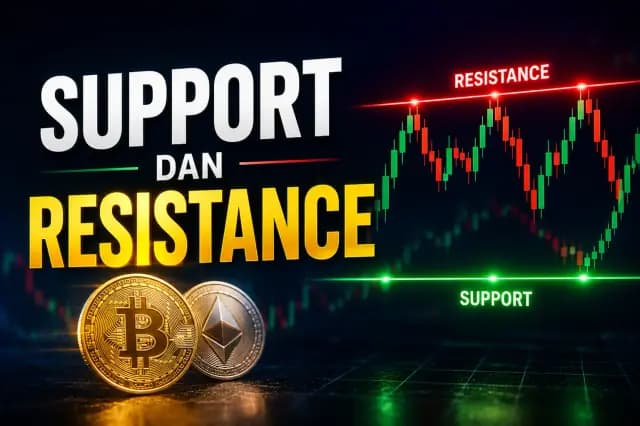
- Technical Factors: Transaction volume, chart patterns, support and resistance levels, and indicators such as RSI, MACD, and Bollinger Bands.
- External Factors: Global news, government policies, institutional adoption, and overall market sentiment.
A combination of these three factors causes the crypto market to be highly dynamic and volatile. This poses a huge opportunity for experienced traders, but also a high risk for beginners who don’t have a firm grasp on the market’s mechanisms.
Analysis in Crypto Trading
To make a rational decision, traders rely on three main approaches.
Technical Analysis/TA
Utilizes data on historical price and volume to predict future price changes. Indicators such as Moving Average, MACD, RSI, and Fibonacci Retracement are used to determine entry and exit points.
Fundamental Analysis/FA
Berfokus pada nilai intrinsik suatu aset. Trader menilai kualitas proyek, tim pengembang, roadmap, serta tokenomics untuk menentukan apakah suatu aset undervalued atau overvalued.
Focuses on the intrinsic value of an asset. Traders make their judgment based on the quality of a project, its developer, roadmap, and tokenomics to determine whether an asset is undervalue or overvalued.
Sentiment Analysis
Analyzes the market’s psyche through news, social media, and community discussions. For example, a jump in the keyword “bitcoin halving” on Google may indicate an increase in public interest.
Experienced traders combine the three approaches above to improve accuracy in decision-making.
Risks and Challenges in Crypto Trading
Despite opportunities for huge profits, crypto trading possesses high risk that cannot be overlooked.
- Extreme Volatility: Prices can change by 10–30% in just a few hours.
- Security Risks: Cyber threats in exchanges, scams, and rug pulls are still common.
- Lack of Global Regulation: Some countries do not have clear regulations to protect investors yet.
- The Trader’s Emotion and Psyche: Greed and fear often push traders to make impulsive decisions.
Discipline, proper strategies, and emotional management are necessary keys in surviving the crypto trading world.
Strategies and Safe Tips for Beginners:
Here are the basic principles that must be applied by new traders who are just starting out.
- Do Your Own Research — Understand the assets you are trading, including its fundamentals and market trends.
- Use A Small initial Capital — Avoid using essential funds or loans for trading.
- Use Stop-Loss and Take-Profit — This limits loss and secures profit.
- Portfolio Diversification — Avoid focusing on just one asset.
- Use A Trusted Platform — Make sure the exchange is officially registered in Bappebti or is globally reputable.
- Combine Technical and Fundamental Analyses — To avoid making decisions based on emotions.
- Record and Evaluate Each Transaction — Utilize a trading journal to improve future trades.
Crypto Trading Regulations in Indonesia
In Indonesia, crypto transactions are regulated by Bappebti (Badan Pengawas Perdagangan Berjangka Komoditi). Only officially registered exchanges are allowed to operate. Some examples of legal platforms include: Indodax, Pintu, Reku, Tokocrypto, and DRX.
Although crypto is not recognized as a legal method of payment in Indonesia, it is recognized as a digital commodity that can be traded. This regulation provides legal protection for traders and maintains the stability of the ecosystem.
The Future of Crypto Trading
The development of blockchain technology and artificial intelligence (AI) will push massive transformations in the world of crypto trading. Automatic algorithms and bot trading are already used to execute transactions efficiently based on real-time analysis.
Not to mention, an increase in institutional adoption from large companies like BlackRock, Tesla, and Fidelity shows that the traditional world finance is starting to take the crypto market more seriously.
In the next few years, we will most likely see deeper integration between decentralized finance (DeFi), tokenization, and AI-based automatic trading.
Conclusion
Crypto trading is a high-risk activity, but it has the potential for large profits to those who understand how it works. By understanding the market’s fundamentals, types of trading, analyses, and risk management, each trader can increase their chances of success in this dynamic world of digital assets.
The main keys remain the same: education, discipline, and emotional management. The crypto market is not about who is the first to earn profits, but who is the most consistent and wise in understanding the market.