Main Principles of Technical Analysis
Before learning about cryptocurrency trading indicators, investors should understand three key principles in technical analysis.
1. Prices Contain All Information
All factors—economic, political, and even market sentiment—are already reflected in price changes. Traders only need to read the charts to understand market dynamics without having to monitor the news every hour.
2. Price Moves in Trends
Trends are the dominant direction of price movements, whether upwards (bullish), downwards (bearish), or sideways (consolidation). Experienced traders understand that “the trend is your friend”—following trends is often safer than fighting them.
3. History Often Repeats
Price change patterns often reflect recurring human psychological behaviors—such as fear when prices fall or euphoria when prices rise.
Key Components of Crypto Technical Analysis
To understand how the market shifts, traders typically use three important elements:
1. Price Trends
Trends indicate the dominant direction of the market. If prices form higher peaks and troughs, it is a sign of an uptrend. Conversely, a gradual decline indicates a downtrend.
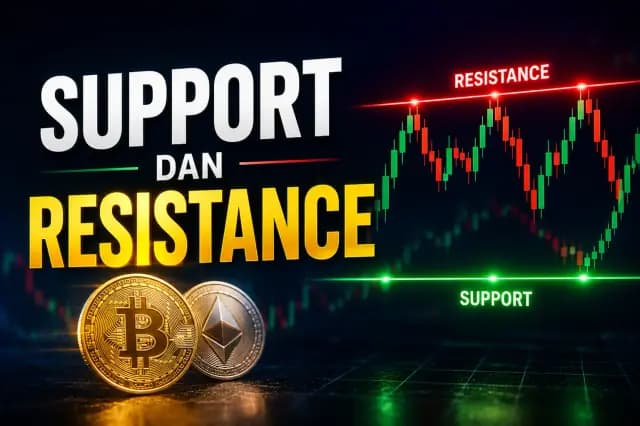
2. Support and Resistance
- Support: a price level where demand is strong enough to prevent a decline.
- Resistance: a level where selling pressure is high enough to prevent an increase.
Example: If Bitcoin fails to surpass $70,000 several times, that area can be considered strong resistance.
3. Trading Volume
Volume helps confirm the strength of a trend. For example, a breakout accompanied by high volume indicates a more valid signal than low volume.
How to Read Crypto Charts
Reading price charts is the basis of cryptocurrency technical analysis.
The three most commonly used charts are::
- Line Chart – displays simple closing price movements. Suitable for beginners.
- Bar Chart – displays the opening, closing, highest, and lowest prices.
- Candlestick Chart – most popular in the crypto world because of its informative visuals.
Each candlestick shows price movements within a specific period (e.g., 1 hour, 4 hours, 1 day):
- Green body = price increases (bullish)
- Red body = price decreases (bearish)
- Wick/shadow shows fluctuations between the highest and lowest prices.
Candlestick patterns such as Doji, Bullish Engulfing, and Hammer are often used by traders to read potential price reversals.
Most Popular Trading Indicators in Cryptocurrency
These technical indicators are most often used by professional crypto traders:
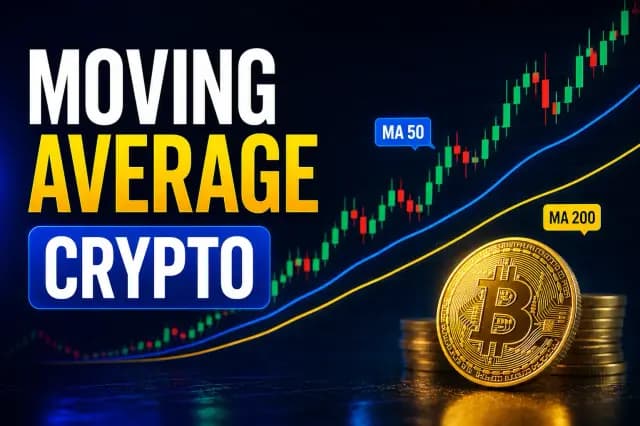
1. Moving Average (MA dan EMA)
Smoothens out price data to identify short- and long-term trends.
- MA (Moving Average) = simple average
- EMA (Exponential Moving Average) = emphasizes recent price movements
Example strategy: Golden Cross (EMA50 crosses EMA200 from below) typically signals the start of an uptrend.
2. RSI (Relative Strength Index)
RSI measures price movement momentum between 0–100.
- 70 = overbought (price is too high, potential for decrease)
- <30 = oversold (price is too low, potential for increase)
RSI helps traders determine whether the market is “tired” and ready to reverse direction.
3. MACD (Moving Average Convergence Divergence)
Measures the relationship between two different moving averages. If the MACD line crosses the signal line from below → bullish potential.
If it crosses from above → bearish potential.
4. Bollinger Bands
Three lines (upper, middle, lower) that help measure price volatility. When the bands narrow → the market tends to be calm (there will be a big movement). When the bands widen → the market is volatile.
5. Fibonacci Retracement
A popular tool for determining correction levels and potential entry points. Common levels: 0.382, 0.5, and 0.618 — these often serve as price reversal points before continuing the trend.
Technical Analysis Strategies for Crypto Traders
Here are some common approaches that can be applied in the crypto market:
1. Trend Following
The simplest strategy: follow the main trend direction. Use EMA or trendlines to determine buy or sell positions.
2. Breakout Trading
The enter position is indicated by the price breaking through significant resistance or support. However, be wary of false breakouts—use significant volume as confirmation.
3. Swing Trading
Take advantage of medium-term fluctuations (1–7 days). Suitable for traders who cannot monitor the market at all times.
4. Scalping
An ultra-fast strategy: open and close positions in minutes. This strategy has lower transaction costs but requires speed and high discipline.
Risks and Limitations of Crypto Technical Analysis
No system is 100% accurate. Although useful, crypto technical analysis still has weaknesses:
- It does not consider news or market sentiment.
- It can produce false signals in sideways markets.
- It is highly dependent on the trader's experience in reading patterns.
Hence, many professional traders combine technical analysis with fundamental analysis of crypto to achieve more balanced results.
Combining Technical and Fundamental Analyses: A Smarter Approach
For example:
- RSI shows oversold areas,
- And fundamentally, the project has just launched a new feature
- → Then the chances of a rebound price are higher.
This approach is often used by professional analysts at institutions like Messari or Delphi Digital.
Some of the most popular platforms for cryptocurrency technical analysis include:
- TradingView → interactive graphics with hundreds of indicators
- CoinMarketCap & CoinGecko → monitors prices, volume, and market capitalization
- Binance / Bybit Chart Tools → direct integration with trading execution
- Glassnode / Santiment → on-chain analysis to complement technical analysis
Common Mistakes in Crypto Technical Analysis
- Using too many indicators at once → Confusing, creates contradictive results.
- Not using stop-loss → Risk management is a trading account’s key to survival.
- Overreliance on a single signal → Always use volume, patterns, and market context to confirm.
- Emotional trading → Technical analysis isn’t a tool to “make up for losses,” but an objective guide.
Conclusion: Technical Analysis is a Compass, Not a Forecast
Crypto technical analysis is not a tool for predicting the future; it is a compass for navigating market volatility. By understanding trends, price patterns, and key indicators, traders can make more rational decisions and reduce emotional risk.
In a highly dynamic crypto world, technical analysis is not optional, but necessary.
Aside from understanding technical analysis, it is important to have a clear grasp of concepts like Crypto Market Caps, which determine the market value of an asset, as well as Volatility, which measures risks and price shifts in the market.
However, keep in mind that without discipline and risk management, even the best indicator cannot protect your portfolio. Still confused about all the terms in crypto trading? Visit DRX Token's Dictionary to learn over 70 important terms to understand the digital asset market.
FAQ: Frequently Asked Questions About Crypto Technical Analysis
1. What is crypto technical analysis?
Crypto technical analysis is a method to read historic price data to predict market movements and determine the best entry/exit points.
2. What is the most accurate indicator in crypto trading?
There is no one perfect indicator, but a combination of MA, RSI, and MACD are often used to read trends and momentum.
3. Is technical analysis suitable for long-term investors?
Yes, if it is combined with fundamental analysis to identify the best buy and sell momentum.
4. How to learn crypto technical analysis for beginners?
Start by understanding candlesticks, trends, and one simple indicator (e.g., RSI). Use a demo account on TradingView or Binance.
5. Can AI replace technical analysis done by humans?
AI can detect patterns faster, but intuition and social context remain crucial in understanding market sentiments.