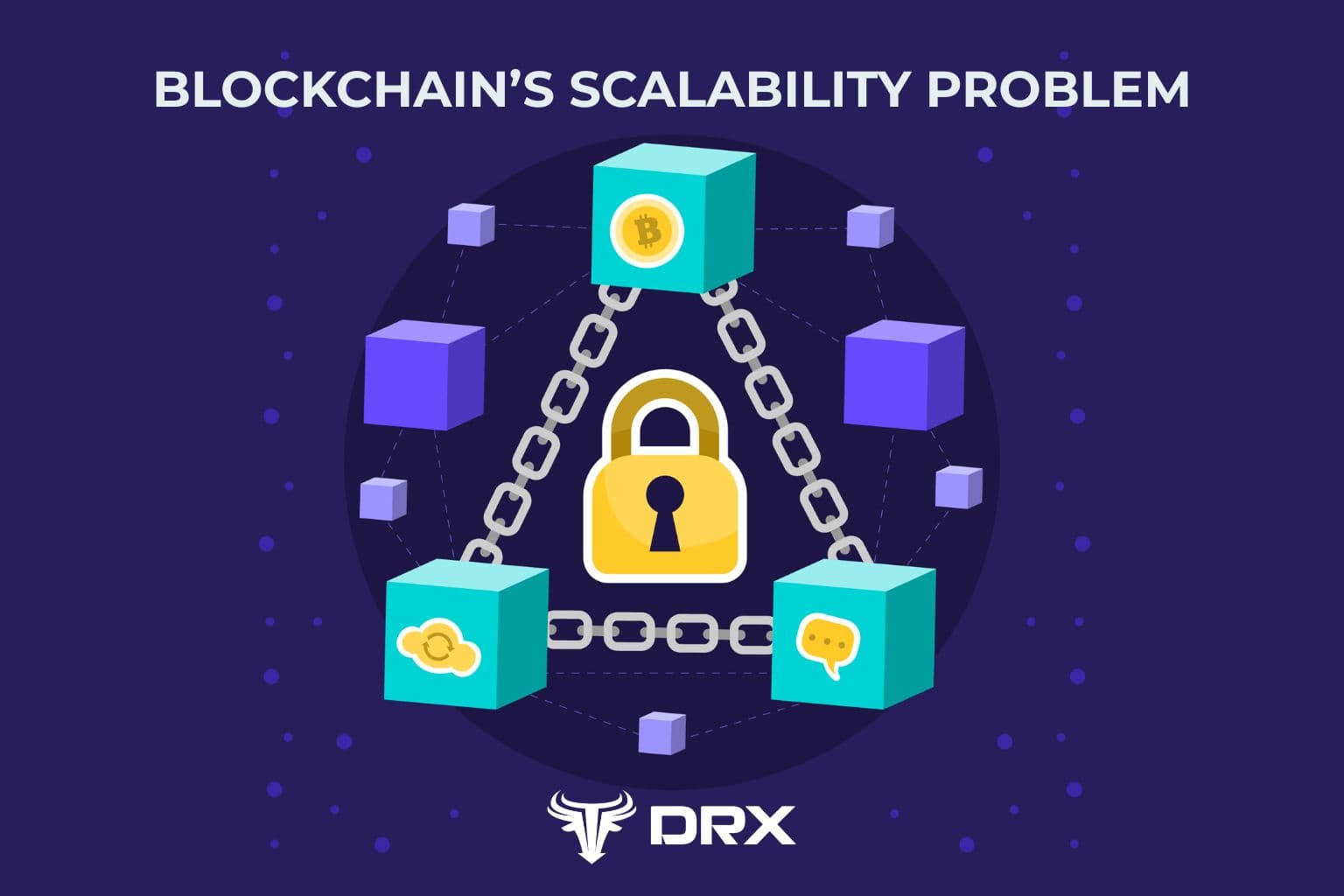
- Decentralization: The principle of distributing the blockchain across multiple computers in a network instead of storing it in a single centralized location.
- Security: The ability of the blockchain to withstand attacks or unauthorized changes. Generally, the more decentralized a blockchain is, the more secure it is.
- Scalability: The ability of a blockchain to handle more workload.
To develop two factors, the other factor must be reduced or sacrificed. Scalability is a major problem in blockchain because to increase it, security or decentralization must be reduced.
Layer 1 and Layer 2 Blockchain Scalability Solutions
As a solution to blockchain scalability, the concepts of Layer 1 and Layer 2 have emerged.
Layer 1
Layer 1 refers to the main blockchain network. This layer facilitates transactions and activities on the blockchain. Examples of Layer 1 blockchains are Bitcoin, Ethereum, Algorand, Cardano, and others.
In order to facilitate a larger number of transactions, Layer 1 blockchains implement blockchain scalability solutions such as:
- Changing the Consensus Mechanism: Some consensus mechanisms in blockchains are not efficient for improving scalability, so they must be replaced. For example, Ethereum switched from proof-of-work consensus to proof-of-stake to reduce energy consumption by up to 99.95%.
- Blockchain Fork: Upgrading or resetting the blockchain. This is divided into soft forks (changes in the blockchain protocol that are still compatible with the old chain nodes) and hard forks (changes to a new operating mode that are incompatible with old nodes if they are not updated).
- Sharding: Data is partitioned into small portions so that it can be processed more quickly.
Layer 2
Layer 2 is a layer built on top of the main blockchain to improve the performance of the main network. Layer 2 groups transactions into small bundles, processes them outside the main network, and then sends them back to layer 1. Examples of layer 2 blockchains are Optimism, Polygon, Arbitrum, and Loopring.
Layer 2 scalability solutions include:
- State Channel: Some transactions are sent to a multi-signature wallet outside the blockchain. Participants in the state channel will transact directly using multi-signature contracts without involving miners for verification.
- Rollups: A Layer 2 blockchain scalability solution that groups transactions from the main network, processes them outside the blockchain, and then sends the processed transactions back to the main network.
- Optimistic Rollups: Assume all transactions are valid unless challenged. Anyone can challenge the validity of a transaction during the challenge period.
- Zero-Knowledge (ZK) Rollups: Prove transaction validity using cryptographic evidence called validity proofs. Only valid transactions can run on the main blockchain layer.
- Nested Blockchain: A Layer 2 blockchain scalability solution consisting of a parent chain and branch chains. The parent chain delegates transactions to its branches. Transactions are processed on the branch chains before being sent back to the parent chain. The parent chain then completes layer 1 with the transaction results.
- Sidechain: A layer 2 blockchain scalability solution that runs parallel to the main chain to optimize performance. Sidechains are independent, and attacks on side chains will not affect the main chain.
Also Read: What is Layer-2 Blockchain? How it Works and Advantages Over Layer-1
Sharding
Sharding is one of the blockchain scalability solutions that takes place at layer 1. Data is divided into small pieces called “shards.” Then, all shards are processed in parallel.
How Sharding Works
- Network Division: The blockchain network is divided into several segments or shards. Each shard has a subset of the network's overall data, but it is unique and independent from other shards.
- Parallel Processing: Each shard processes transactions in parallel with other shards.
- Communication Across Shards: Each shard can still share information with other shards, so the data can still be accessed by all users to uphold blockchain’s decentralization principle.
Advantages of Sharding
- Increased Scalability: Sharding increases the TPS (transactions per second) of a blockchain, as the processing load is distributed among many shards.
- Reduced Workload: Sharding reduces network latency because it essentially breaks a network down into smaller parts.
- Improved Efficiency and Speed: Transactions are faster and more efficient because they are processed in parallel across multiple shards.
Disadvantages of Sharding
- Security Risks: Sharding creates potential for attacks, such as exploiting security vulnerabilities in shards or coordinating attacks across shards.
- Data Fragmentation: Data is divided across multiple shards, making it more complex to access the complete history of a blockchain or validate transactions across multiple shards.
- Network Partitioning: If a shard is isolated or offline, it can impact the availability and functionality of that shard or even the entire network.
Rollups
Rollups are a blockchain scalability solution that takes place on Layer 2, which groups several transactions into one batch and then processes them outside the main blockchain.
How Rollups Work
- Optimistic Rollups
- Challenge Period: All transactions are considered valid and sent to the main chain without the need for proof. After that, there is a challenge period to dispute the validity of a transaction.
- Fraud Proof: If an invalid transaction is detected, fraud proof is submitted. If fraud proof is accepted, the batch of invalid transactions will be rejected.
- Advantages:
- Higher Throughput: Transactions are processed outside the chain, reducing congestion on the main layer.
- Cost Savings: Computation on Layer 1 is reduced, resulting in lower transaction fees.
- Disadvantages:
- Slower Finalization: Optimistic rollups involve a challenge period before transactions are finalized on Layer 1.
- Less Security: The security of optimistic rollups depends on honest validators who have an incentive to detect fraudulent transactions and submit fraud proofs.
- Zero-Knowledge (ZK) Rollups
- Zero-Knowledge (ZK) Proof: Proof of validity sent to the main protocol. This system is divided into two main classes:
- zk-SNARK (Zero-Knowledge Succinct Non-interactive Argument of Knowledge): Non-interactive, meaning there is no further communication between the validator and the verified party after the proof is created.
- zk-STARK (Zero-Knowledge Scalable Transparent Argument of Knowledge): Uses hash functions to generate proofs, thereby improving security, scalability, and transparency.
- Advantages:
- Faster Finalization: ZK-Rollups have no challenge period, so transactions can be finalized on Layer 1 faster.
- More Secure: ZK-Rollups are protected by the security and decentralization of the Layer 1 blockchain and cryptographic proofs to validate transactions.
- Disadvantages:
- More Complex: In-depth knowledge and complex infrastructure development are required before ZK-Rollups can be implemented in the blockchain ecosystem.
Conclusion
Scalability is a part of the blockchain trilemma. To improve blockchain scalability, blockchain security or decentralization must be compromised. Hence, various blockchain scalability solutions have emerged, such as sharding and rollups.
In fact, additional networks have been formed to improve blockchain scalability. Learn about Layer 2 as a blockchain scalability solution in the article Understanding Layer 2 Blockchain: A Scalability Solution for Web3.